
What’s new?
13 August 2026 – Important Information for Traders — Clarification on the Retrospective Issuance of the certificate of origin under the China Zero Non-Reciprocal Tariff Treatment
Rule 46A6.13 (e) of the Customs and Excise Act No.91 of 1964 as amended makes provision for a certificate of origin to be issued retrospectively within one (1) year from the date of shipment, bearing the words “ISSUED RETROSPECTIVELY” and remains valid for one (1) year from the date of shipment, if it is not issued before or at the time of shipment due to force majeure, involuntary errors, omissions or other valid causes including non-availability of such certificates from the South African Revenue Service.
The zero-tariff treatment applies to goods that are cleared through the General Administration of Customs of the People’s Republic of China (GACC) on or after 00:00 (Beijing time) on 01 May 2026. The shipment date from the country of export is not the determining factor. Therefore, the determining factor will be the clearance date with the GACC which makes that consignment eligible for the zero-tariff preference provided that all other origin requirements are met. Goods that arrived in China and were placed in a bonded warehouse before 01 May 2026 will also be eligible, provided they are entered for home consumption in China on or after 01 May 2026 and meet all other origin requirements.
SARS will issue and certify the retrospective certificates of origin for goods that have been cleared in China on or after 01 May 2026 in line with Rule 46A6.13 (e) above, provided all origin requirements are met.
Please direct any queries or requests for clarification to: [email protected].
- 30 May 2026 – Media Release: SARS clarifies implementation of China’s Zero-Tariff Export Scheme
The Commissioner of the South African Revenue Service, Dr Johnstone Makhubu, said that SARS has finalised the legal and operational framework to administer China’s zero-tariff scheme. The Rules in terms of section 46A of the Customs and Excise Act, 1964, regulating the issuing of certificates of origin are available on the SARS website. From 1 June 2026, SARS will be issuing Rules of Origin certificates for qualifying exports. See the full media release here.
- 8 May 2026 – Notice: China Zero-Tariff Trade Implementation
This notice informs all traders that the China trade scheme officially came into effect on 1 May 2026. It is, however, important to note that some tariff lines are subject to tariff-rate quotas (TRQs). The South African Revenue Service (SARS), in consultation with the Chinese Authorities, is finalising the legal framework required for the scheme and is establishing the system to issue Rules of Origin Certificates.
Once the necessary legislation is in place, certificates will be issued retrospectively from the effective date of 1 May 2026. SARS is committed to implementing this process smoothly and will update stakeholders on the application procedure and documentation requirements as soon as the system to issue the certificates is operational.
We encourage all traders who wish to participate in the China trade scheme to stay informed and prepare for the upcoming processes. Please direct any queries or requests for clarification to [email protected].
Frequently Asked Questions
It is a non-reciprocal zero-tariff treatment for goods exported from the Republic of South Africa to the People’s Republic of China on compliance with the provisions of origin. A temporary arrangement pending the conclusion of the China-Africa Economic Partnership Agreement (CAEPA) that will involve a reciprocal arrangement between SACU and China and provide more clarity and certainty.
The scheme is only for two (2) years, starting from the 01 May 2026 to 30 April 2028. It operates under the Early Harvest Lite (EHAL), a temporary arrangement pending the conclusion of an Early Harvest Agreement (EHA) that will include the Southern Africa Customs Union (SACU). The EHA will involve a reciprocal arrangement (CAEPA) between SACU and China.
All products are subject to zero-tariff treatment. However, there are tariff rate quotes for some products. See the applicable tariff schedule access here.
Section 46A of the Customs and Excise Act, (Act 91 of 1964), see the Rule Amendment.
No specific registration for a trade agreement, all registered exporters are eligible to export under the scheme.
The branches that are authorised are:
1. Alberton / Johannesburg
2. Cape Town
3. Cape Town International Airport
4. Durban
5. East London
6. King Shaka Int.
7. OR Tambo International Airport
8. Port Elizabeth
9. Pretoria
The list of Operational Managers and their emails is below, scroll down.
You may send it to [email protected].
You need a certificate of origin to benefit when exported into China’s market.
The existing application form on the Rules of Origin webpage SC-RO-02-A02 – Application for Export Origin Certificates must be used until the new form is amended.
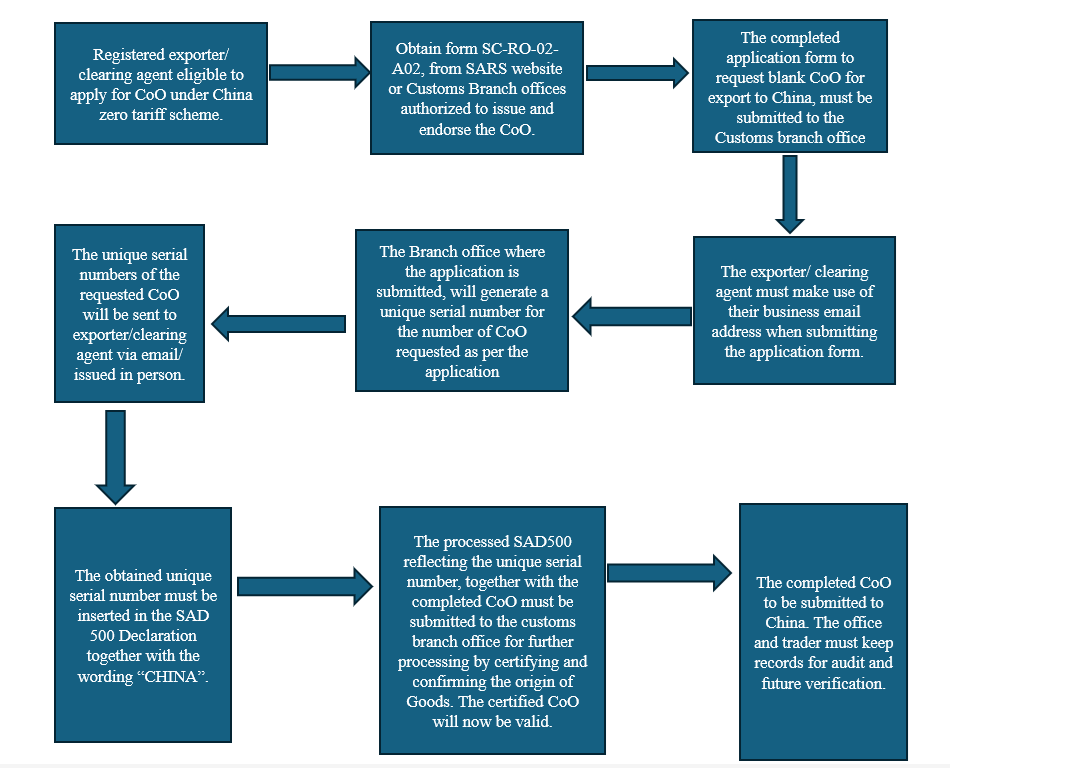
Traders must apply for the certificates of origin on the SC-RO-02-A02 – Application for Export Origin Certificates form. The form must be completed and submitted to the Customs and Excise branch with relevant supporting documents. The branch will consider the application form and once approved, will send the certificate of origin that has a unique certificate number for the Trader to complete all relevant fields for further certification. It is mandatory for the trader to include the details of the certificate on the SAD 500 under ‘additional field”.
The certificate of origin becomes valid once the trader completes the required fields, submit it back to the issuing office for certification, authentication and verification of origin of goods, and it has been stamped and signed off by the issuing office. Unique certificate number helps prevent transferability and potential misuse.
Traders can apply for retrospective issuance of the certificate of origin for goods exported from the 01 May 2026.
Records must be kept for 5 years in accordance with the Customs and Excise Act (Act 91 of 1964) for future verification requests and audits.
Traders are encouraged to apply for an origin determination for clarity and certainty. The SC-RO-02-A02 – Application for Export Origin Certificates form is available under the Rules of Origin webpage.
The scheme has provisions for the issuance of retrospective, duplicate and replacement of certificate of origin. Applications of these certificates of origin are available at the authorised customs and Excise offices.
See the applicable Rules of Origin here.
Preferably, yes. If transiting:
- Goods must remain under customs control.
- No further processing allowed.
Storage limited to 6 months.
Shipment below USD 1000, may not require CoO, however splitting shipments to avoid compliance is prohibited.
Steps to apply for a certificate
Contact details of Offices issuing and certifying certificates
NO | OFFICE | EMAIL ADDRESS | NAME OF OPERATIONAL MANAGERS |
1. | Alberton | Derick Dick Chareldine Robinson – QA | |
2. | Cape Town | Customs BFE – issuing of certificates Customs Hub – certifying certificates of origin | Shane Cloete – Customs BFE Magdalene Fouten – Customs Hub |
3. | Cape Town International Airport | Tiaan Burger Anette Kotze | |
4. | Durban | Himla Sookdhaw – Issuing of blank certificates only Lidia Phakathi – Processing of certificates | |
5. | East London | Unathi Faltein Nonkululeko Sofute | |
6. | King Shaka Int. | Zabanguni Gumede Beryl Moshesh | |
7. | OR Tambo International Airport | Jacob Mkhatshwa Alzira Witbooi | |
8. | Port Elizabeth | Lee-anne Maidza Imtiethaal Lee | |
9. | Pretoria | Thobeka Fekisi Prudence Botopela | |
10 | Escalations | Customs & Excise Command Centre [email protected] | William Komane |