
Purpose
The purpose of this webpage is to inform travellers of their obligations and entitlements when entering or leaving South Africa in relation to the declaration of goods and the application of duty-free allowances.
This webpage aims to:
- Explain the requirement for all travellers to declare goods acquired abroad, goods that were processed or repaired outside South Africa, and goods that are prohibited, restricted, or otherwise controlled;
- Provide clarity on the different declaration methods available, including online declarations, manual submission via the Traveller Declaration (TD-01), and verbal declarations where applicable;
- Outline the duty-free allowances, flat rate provisions, and consumable goods allowances available to travellers, including applicable conditions, thresholds, and limitations; and
- Assist travellers in determining whether their goods fall within the allowable limits and to prepare for any duty or tax assessment where allowances are exceeded.
Scope
The scope of this webpage includes:
- All persons crossing South African borders, including South African residents, non-residents (visitors), and crew members of ships and aircraft;
- Goods imported or exported as accompanied baggage, including new or used goods, personal effects, consumable goods, and handmade articles within prescribed limits;
- The duty-free allowance, flat rate allowance, and consumable goods allowances applicable to travellers, including qualifying criteria, thresholds, and limitations;
- The treatment of goods imported from international countries and from Southern African Customs Union (SACU) and Southern African Development Community (SADC) member states;
- The declaration process at ports of entry and exit, including online declarations, manual declarations (Traveller Declaration – TD-01), and verbal declarations where required;
- The procedures applicable at different types of ports of entry, including land borders, seaports, and international airports (red and green channel system);
- The requirements relating to prohibited, restricted, and controlled goods, including goods requiring permits or subject to specific legislative controls; and
- Travellers in transit through South Africa, including applicable Customs formalities and exceptions.
This webpage does not apply to the importation or exportation of commercial goods (excluding qualifying handmade articles) or goods carried on behalf of other persons, which must be declared and cleared in accordance with the relevant Customs procedures.
When Leaving the Country
- South African residents may elect to register their identifiable valuables with Customs prior to leaving the country on a Traveller Goods Declaration (TGD1) which should be produced upon return as proof of re-importation.
- Currency limits are specified in SC-PA-01-06 – Excess Currency – External Policy and must be declared accordingly.
When Arriving in the Country
Personal effects
- Returning residents are allowed to re-import personal effects, sporting and / or recreational equipment without the payment of duties and taxes. The goods must be identifiable as the same goods which were exported from South Africa for own use while abroad. Customs may detain such goods pending proof of local purchase or proof of declaration prior to original export.
- Visitors to the country may import personal effects, sporting and / or recreational equipment for their own use while in South Africa without the payment of duties and taxes. Customs may require a deposit to be lodged which is refundable after re-exportation of the goods.
Duty-free allowance on new or used goods imported as accompanied baggage
- Travellers from international countries are entitled to import goods, excluding consumable goods of paragraph below), up to a value of R5 000 per person without paying any duty or tax thereon.
- Crew members (including the master / pilot) are only entitled to a duty-free allowance of R 700.
- The duty-free allowance will only be granted once per person in a thirty (30) day cycle after an absence of 48 hours or more. For example, a person returning for the second time within thirty (30) days will not qualify for the duty-free allowance. Similarly, a person after an absence of 36 hours will not be entitled to the duty-free allowance.
- Travellers from the Southern African Customs Union (SACU) member countries:
- Do not pay Customs duties; and
- Are entitled to a VAT exemption on goods up to a value of R100 000 once during a thirty (30) day cycle after an absence of 48 hours or more from the country, provided that the goods do not exceed R100 000.
- Consumable goods
- Travellers are entitled to import free of duty or tax consumable goods not exceeding the specified limits; being:
- 200 cigarettes;
- 20 cigars;
- Combined 250-gram pipe and / or cigarette tobacco;
- 2 litres of wine;
- 1 litre of other alcoholic beverages (including beer);
- 250 ml eau de toilette; and
- 50 ml perfume.
- Consumable goods in excess may not be claimed under the duty-free allowance. Full duty and VAT must be paid on such excess consumables.
- The consumable goods allowance is:
- In addition to the duty free and flat rate allowances; and
- Allowed once per person in a thirty (30) day cycle after an absence of more than 48 hours.
- Crew members (including the master / pilot) are not entitled to any duty-free consumable goods.
- Tobacco and alcohol allowances are not allowed to persons under the age of eighteen (18).
- Travellers are entitled to import free of duty or tax consumable goods not exceeding the specified limits; being:
Flat rate allowance (allowable in addition to the duty-free allowances)
- The flat rate allowance provision allows the importation of additional new or used goods above the duty-free allowance, to the value of R20 000 at a rate of 20%. VAT in this instance is also exempted.
- Crew members (including the master / pilot) are only entitled to goods to the value of R2 000.
- The traveller may request the Customs Officer, before the assessment takes place, not to apply the flat rate but to assess the goods at the relevant rates of duty and VAT.
- This flat rate allowance is only applicable to international travellers and not travellers from SACU member countries.
- The flat rate allowance will be granted an unlimited number of times during the thirty (30) day cycle after an absence of 48 hours or more from the country, provided that the value of the goods does not exceed R20 000 in total. For instance, if a person paid the 20% flat rate on goods of a value of R6 000 and then returns from a second absence of 48 hours, this person can pay the flat rate on the remainder of the allowance (i.e. goods up to a value of R14 000).
Handmade articles for commercial purposes:
- Travellers from SACU or the Southern African Development Community (SADC) member states are allowed to import handmade articles of leather, wood, plastic, stone, or glass without the payment of duties or taxes, if the goods:
- Are of SACU or SADC origin; and
- Do not exceed 25 kg in total.
- The handmade articles are allowable once per person during a period of thirty (30) days.
- These goods up to the limits stated may be declared on the TGD1 even though the goods are intended for commercial purposes.
Additional qualifying criteria and restrictions
- Persons travelling together (family members) must each make an individual declaration, and parents / guardians may assist minors in completing the declaration.
- Allowances may not be pooled by people travelling together; for example, a husband and wife travelling together may not claim a duty-free allowance of R10 000 on a single television set worth R9 000.
- Goods must be of a personal nature for own use or to be given as gifts.
- Minors, accompanied or not, are entitled to the traveller allowances on condition that the goods are for their personal use.
- Commercial goods (excluding handmade articles of rebate item 410.04) and goods carried on behalf of other people do not qualify for any allowance.
- Prohibited goods may not be imported, for example:
- Narcotics and habit-forming drugs;
- Military weapons;
- Poisons and toxic substance;
- Penitentiary or prison-made goods; and
- Explosive and fireworks.
- Restricted goods may only be imported under certain circumstances, such as under permit or quota. Examples of such goods are the following:
- Firearms;
- Animals, plants and their products;
- Medicine
- Unprocessed minerals; and
- All gold coins or South African or bearer instruments or foreign currency exceeding amounts specified in SC-PA-01-06 – Excess Currency – External Policy.
- Firearms cannot be claimed under any traveller allowance.
- Travellers may import their personal medicines provided it is for not more than three (3) months’ use. This must be accompanied by a prescription issued by a medical doctor.
Travellers in transit
- Travellers in transit to countries outside SACU, who have been booked from an airport outside the SACU member countries, are not required to comply with Customs formalities in South Africa.
- Travellers arriving in South Africa and taking a connecting flight to another SACU member country are required to complete all Customs formalities upon arrival.
- Baggage belonging to travellers in transit will automatically be transferred from the international flight at the airport of transit in South Africa. These travellers must not leave the transit area of the airport between flights.
- Travellers arriving in South Africa who are continuing to another destination in South Africa by air, are not considered to be in transit and their baggage cannot be booked to a direct domestic destination. The travellers must proceed through to Customs on their arrival.
- Travellers continuing to their destination by road must comply with Customs regulations at the port of arrival in South Africa.
Examples of the traveller allowances
- On goods within the duty-free allowances (R5 000), no duties or VAT are levied.
- Goods exceeding the duty-free allowance of R5 000 but within the flat rate threshold:
- The traveller will still be entitled to the duty-free allowance on goods up to a value of R5 000.
- Travellers arriving from SACU destinations receive a VAT exemption on goods up to a value of R25 000 and no flat rate is applicable.
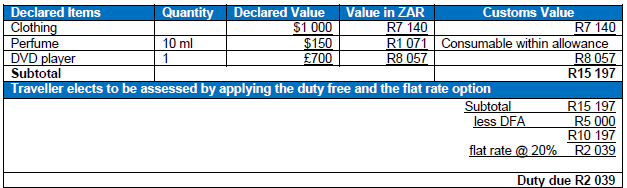
- Multiple goods exceeding the flat rate threshold:
- In the event where the total value of all the goods (excluding the consumables) exceeds R25 000 the traveller will need to indicate which items are to be assessed in terms of the traveller allowances, i.e. duty free and flat rate allowance, and which goods must be assessed according to the relevant rates of duty and VAT.
- The goods allocated will be assessed according to the declared values, in other words the tariff assessment will not be based purely on the amount above the R25 000 threshold.
- Travellers from SACU destinations will receive a VAT exemption on goods up to a value of R25 000. The item(s) more than the threshold will be assessed for VAT on the full declared value.

- In this example the traveller chooses the Digital recorder and TV Monitor to fall inside the duty-free allowance:
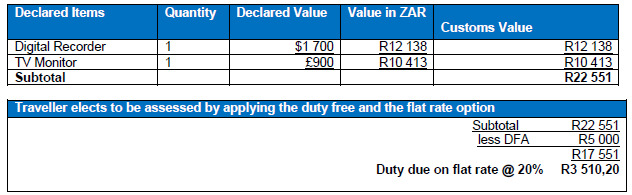
- The remaining items i.e., clothing and DVD player must be assessed by applying ordinary rates of duty and VAT.
- Single items exceeding the flat rate threshold:
- If the traveller has a single item exceeding the threshold of R25 000 both the duty-free and flat rate allowances are forfeited and the item will be assessed on the full declared value.
- Such an item will attract the relevant duties and VAT if the traveller arrives from a destination other than a SACU member country.
- Arrivals from SACU member countries will be liable to VAT only on the declared amount; if it exceeds the R25 000 threshold.

- Consumables in excess will be assessed based on the quantity in excess only.
Definitions, acronyms and abbreviations
The definitions, acronyms and abbreviations can be accessed here – Glossary webpage.
Legal disclaimer: In the event of conflict or inconsistency between this webpage and the PDF version of the guide, the latter shall prevail.